
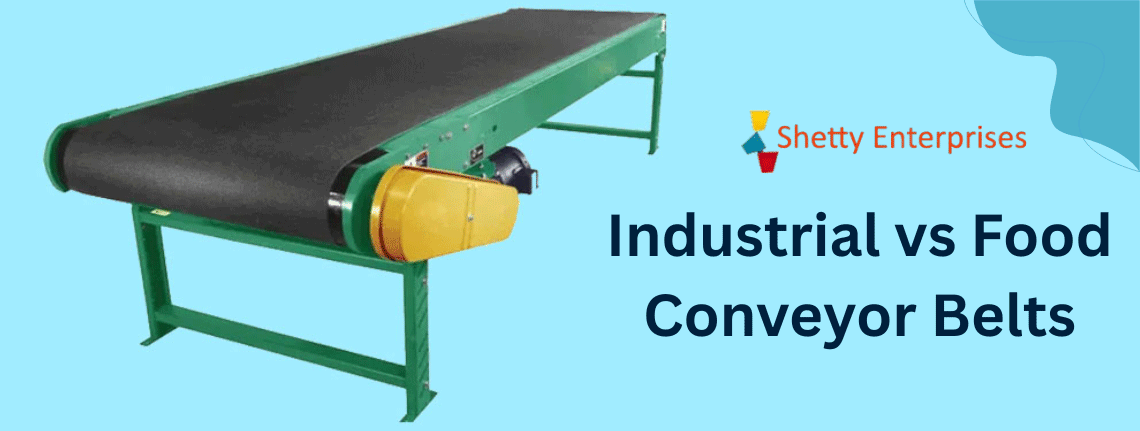
When someone asks us, “Which conveyor belt should I use?” the honest answer is-it depends. Over the years at Shetty Enterprises, we have seen companies spend heavily on machines, automation, processing lines, but overlook the one element that holds the entire process together is the conveyor belt.
Choosing the right belt is not a quick decision. Every industry works differently, every material behaves differently, and every workplace exposes belts to unique conditions. A belt that performs brilliantly in a cement plant may completely fail inside a food processing line. That’s why the comparison between industrial conveyor belts and food conveyor belts is not just technical-it’s practical, financial and even safety-related.
Today, we want to break down the differences the way we explain it to our clients-clear, relatable and based on what we have actually seen in real projects across India.
Our belts are built to handle everything- from lightweight items like bakery products to heavy items like packaged cartons. This flexibility makes them a preferred choice for industries looking for a trustworthy Food Conveyor Belt Manufacturer who understands real ground-level challenges. Every belt is tested for load, temperature resistance, chemical resistance, and surface hygiene. When you choose us, you're essentially choosing a product that’s been tested, improved, and perfected based on thousands of real industrial hours
The conveyor belt is not just a moving surface. It’s the link between your raw material and your final output. One wrong choice can create a chain reaction like-
We have seen companies who thought a “belt is just a belt” and chose the cheapest option-only to realize a few weeks later how expensive that decision really was.
For food companies, the stakes are even higher. A belt that traps microorganisms or reacts with ingredients can ruin entire batches and even risk consumer health.
And in heavy industries, a weak belt can tear while carrying abrasive materials, halting operations for hours or days. That’s why selecting the right belt is not only about product specifications-22it’s about ensuring smooth, uninterrupted operations across your entire facility.
Industrial conveyor belts are designed for environments that are rough, demanding, and often unpredictable. When we work with industries like cement, steel, automotive, mining, chemical production or packaging lines, the first thing we discuss is durability. These belts must handle materials that can be abrasive, sharp-edged, heavy, hot or chemically reactive.
The structure of an industrial belt is built around strength-reinforced layers, tougher polymers and surfaces that can withstand friction and pressure. Many of these belts also need to resist oils, extreme temperatures, outdoor UV exposure and constant mechanical stress.
One thing we’ve noticed over the years is that companies often underestimate the long-term stress on industrial belts. They run for hours without stopping. They carry tons of material. They face conditions that vary from dust-filled areas to high-temperature zones. That’s why industrial belts prioritize toughness over flexibility-because even a minor weakness becomes noticeable very quickly in such environments.
Food conveyor belts work in an environment that is completely different from industrial operations. Here, purity matters more than toughness. Everything inside a food processing unit revolves around hygiene, and the belt plays the biggest role in maintaining it.
These belts need to be non-toxic, easy to clean, resistant to fats and oils, and compliant with food safety regulations. Any belt used in contact with food must not transfer taste, odor, or chemicals to the material being conveyed. That’s why food belts usually have smooth surfaces, minimal crevices, and coatings that prevent bacterial growth.
Temperature also plays a big role. Food belts must stay stable whether they operate in freezing rooms or heated processing areas. Flexibility and ease of cleaning are equally important because belts need regular washing, scrubbing, and sanitizing without degrading.
At Shetty Enterprises, we’ve noticed something interesting—food companies often prefer belts that look “simple,” but those simple belts are engineered with precision for safety, material purity, and long-term hygiene. Their job isn’t to survive rough handling; it's to keep food safe during every second of contact.
Whenever a client approaches us with the question “Industrial belt or food belt?” we guide them through a clear comparison. We always encourage them to think of their belt as a long-term partner, not a one-time purchase.
Here are the points we walk through:
We’ve noticed a pattern over the years-most belt failures start with the same few mistakes. The most common one is choosing a belt only based on price. While cost matters, it should never be the deciding factor.
Another mistake is trying to use the same belt for multiple applications. A belt that works well for dry goods may not work for oily materials. A belt that handles bulk loads might crack under high-temperature conditions.
Some companies also underestimate the impact of cleaning. Food belts need regular washing. If a belt material is not designed for that level of sanitization, it won’t last long.
And then there’s the “let’s try and see” approach. Conveyor belts are not trial products. A poor experiment can lead to downtime, damage or contamination. Selecting without proper guidance eventually costs far more than selecting correctly.
You should choose an industrial conveyor belt when your project involves:
If durability and load-bearing capacity are your top priorities, an industrial belt is the obvious choice. It’s built to perform where conditions are harsh and reliability is non-negotiable.
A food conveyor belt should be chosen when your material directly or indirectly interacts with consumable products. Whether it is fruits, vegetables, bakery items, dough, snacks, spices, meat or pharmaceutical tablets-hygiene takes priority over toughness.
Food belts should also be your default choice when:
In such cases, using anything other than a food-grade belt increases risk and does not comply with basic food safety standards.
Over the years, we have supplied conveyor belts across a wide spectrum of industries in India. What we have learned is that every client has a unique challenge-even if on paper, two projects look similar.
One thing that stands out is how often companies approach us after trying the wrong belt. They share stories of belts tearing too soon, materials sticking, hygiene issues or unexpected shutdowns. These situations taught us how important it is to guide clients with practical examples rather than only technical specifications.
We have also worked with clients who were not sure whether their material was considered “industrial” or “food-grade.” Some had mixed operations-packaging and raw handling in the same line. In such cases, our job becomes figuring out the safest and most efficient middle ground.
These insights help us shape recommendations that actually work on the factory floor.
Our approach is simple: understand first, recommend later.
We start by asking questions about the material, environment, cleaning process, load, speed and expected lifespan. We try to understand not just what the belt must carry, but how the entire process behaves.
Then we compare options-not to confuse clients, but to help them see the impact of each choice. We discuss durability, cost, hygiene, replacement frequency and operational safety.
Most importantly, we share our real experiences. Clients appreciate this because they get to understand how similar companies handled similar challenges.
By the end of the discussion, our goal is to ensure that the client chooses a belt confidently, knowing it will perform reliably in their specific setup.
Selecting between an industrial conveyor belt and a food conveyor belt is not difficult once you know what to look for. Each belt serves a different purpose, and the right choice makes your entire operation more efficient, safe and cost-effective.
When you match the right belt to the right application, everything becomes smoother-production, maintenance, quality, safety and even energy usage.
No. Industrial belts are not designed for food contact and can contaminate materials.
Some are, but it depends on the material. Always check compatibility before choosing.
Frequently. The cleaning schedule depends on hygiene requirements and the type of food processed.
Load, speed, temperature, cleaning, chemicals, and material type all influence longevity.
Yes. Thicker belts last longer in industrial settings, but food belts require a balance between hygiene and strength.
Yes. We often help clients with custom requirements based on their environment and material.
If you’re planning a new project or want to upgrade your existing conveyor system, our team at Shetty Enterprises is always ready to help. We combine industry experience with practical understanding to guide you toward the right belt for your application.
All Copyrights © 2025. Shetty Enterprise
Owned & Powered by : #1 Vinayak InfoSoft - SEO Company Ahmedabad : Disclaimer

